Why use an eSIM in Indonesia?
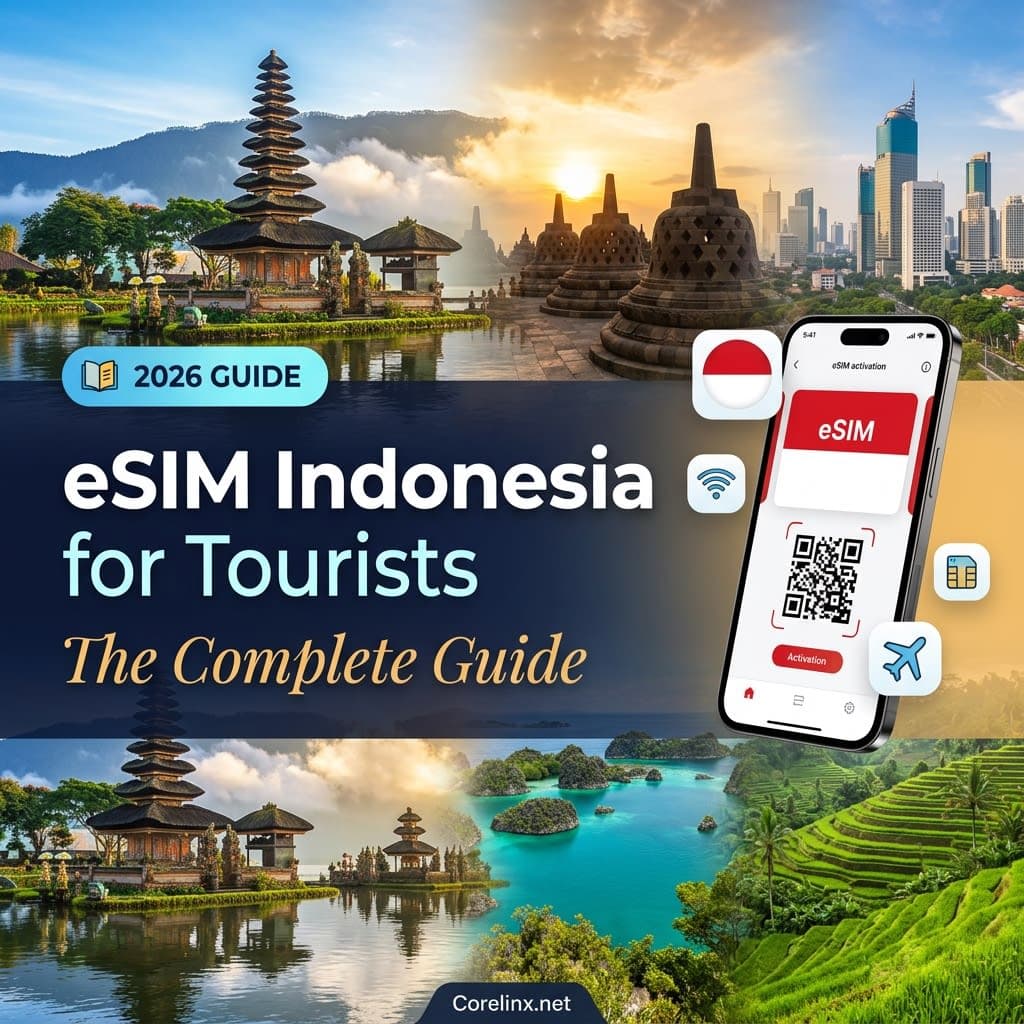
An eSIM is a digital SIM built into your phone. Instead of queuing at an airport kiosk, handing over your passport for registration, and swapping a tiny plastic card, you buy a plan online, scan a QR code, and you're connected. For Indonesia specifically that matters, because the country requires every prepaid SIM to be registered to an identity document — extra time at the counter, often with a language barrier. A travel eSIM skips that line entirely: you arrive already set up and simply switch it on.
- Online on arrival — no kiosk, no queue, no counter paperwork at Denpasar, Jakarta, or Surabaya airports.
- Keep your home number — your physical SIM stays in for calls and texts while the eSIM handles data.
- No roaming bill shock — one fixed price up front instead of unpredictable per-megabyte roaming charges.
- Buy before you fly — install at home on Wi-Fi and activate when you land.
- Island-hop on one plan — the same eSIM works as you move from Bali to Lombok to Java.
Do you need an eSIM for Indonesia?
You don't strictly need one, but for almost every tourist it is the easiest and cheapest way to stay reliably connected. Here's the quick answer:
- Recent phone, short or multi-city trip? A travel eSIM is the best option — instant, no registration, predictable cost.
- Need a local Indonesian phone number for calls? A physical local SIM still has a niche, but most travellers never do.
- Older phone without eSIM support? You'll need a physical SIM or pocket Wi-Fi instead.
For maps, ride-hailing, digital payments, and messaging from the second you arrive, an eSIM wins for the large majority of visitors.
eSIM vs a local SIM card in Indonesia
Buying a local prepaid SIM at the airport can look cheap on the shelf, but Indonesia adds friction that travellers don't always expect. Prepaid SIMs must be registered against an ID, foreign phones used with a local SIM can face additional formalities such as IMEI registration, and you have to physically remove and store your home SIM. A travel eSIM lets you skip the registration process altogether and keep your own number live. The trade-off is that an eSIM gives you data (and often data-only), so if you specifically need a local number for voice calls, factor that in.
Mobile networks and coverage across Indonesia
Indonesia's connectivity runs on a handful of national operators, so what matters is the network your eSIM uses rather than the brand on the label.
- Telkomsel — the largest network with the widest reach, including rural areas, smaller islands, and eastern Indonesia. Usually the safest choice if your itinerary leaves the big cities and tourist hubs.
- Indosat Ooredoo Hutchison (IM3) — strong, fast coverage across Java, Bali, and major urban centres, and good value.
- XL Axiata — solid performance in cities and tourist areas.
- Smartfren — competitive in urban zones.
In well-travelled areas — Bali's south, Jakarta, Bandung, Surabaya, and Yogyakarta — all major networks perform well on 4G/LTE, with 5G live in parts of the largest cities. In remote regions such as Komodo, Flores, Raja Ampat, and the interior of Sumatra or Kalimantan, signal thins out and Telkomsel-backed coverage tends to hold up best. If your trip includes off-the-beaten-track stops, prioritise a plan that runs on Telkomsel.
How much data do you need for Indonesia?
The right amount depends on how you travel. As a rough guide for a one-to-two-week trip:
- Light use (~3–5 GB): maps, messaging, ride-hailing, occasional browsing. Fine for a short, mostly offline holiday.
- Standard use (~8–10 GB): the above plus social media, photo uploads, and some video. The sweet spot for most travellers.
- Heavy use or remote work (15 GB or an unlimited-style daily plan): video calls, streaming, and hotspotting a laptop. Indonesia's large digital-nomad scene — especially around Bali — leans this way.
If you're island-hopping for several weeks, look at a larger allowance or a plan you can top up. When in doubt, start mid-range: topping up is instant, so you avoid paying for data you won't use.
Where you'll use it most: Bali, Jakarta, Yogyakarta, Lombok and beyond
Most trips to Indonesia revolve around a few hubs, and good data makes each one smoother. In Bali, you'll lean on ride-hailing and maps constantly between Canggu, Ubud, and Uluwatu — our dedicated best eSIM for Bali guide goes deeper on island coverage, and the Bali travel guide for first-timers covers the rest of the trip. In Jakarta, you'll want strong urban data for transport apps and QRIS payments. In Yogyakarta, maps and translation help you navigate Borobudur and Prambanan. On Lombok and the Gili Islands, a Telkomsel-backed plan keeps you online as coverage gets patchier. One eSIM covers them all — no swapping SIMs between destinations.
How to set up your Indonesia eSIM in minutes
- Check compatibility. Dial *#06# — if you see an EID number, your phone supports eSIM. (iPhone XS and later, Google Pixel 3 and later, and most recent Samsung Galaxy models qualify.)
- Buy your plan online and choose your data size and validity to match your trip length.
- Scan the QR code you receive by email to install the eSIM. Do this at home on Wi-Fi before you fly.
- Leave it switched off until you arrive, so the validity period doesn't start early.
- Land in Indonesia, turn on the eSIM as your data line, enable data roaming for that line if prompted, and you're online.
That's it — no kiosk, no passport photocopy, no SIM swap on the airport curb.
eSIM vs local SIM vs pocket Wi-Fi vs roaming
Here's how the four ways to get online in Indonesia compare:
- Travel eSIM — instant, no registration, keep your number, fixed price. Best for most travellers with a recent phone.
- Local SIM card — can be cheap, but means queuing, ID registration, possible IMEI formalities, and removing your home SIM. Useful mainly if you need a local number.
- Pocket Wi-Fi — shares one connection across devices, but it's another gadget to carry, charge, and return, with a daily rental cost.
- Home-carrier roaming — the most expensive option by far and rarely worth it for a holiday.
For a solo traveller or couple with modern phones, a travel eSIM wins on convenience and predictable cost.
How to choose the best eSIM for Indonesia
Not all eSIMs are equal. Before you buy, check:
- Network — Telkomsel-backed coverage if you're heading beyond the main cities and tourist strips.
- Data and validity — enough GB for your style, with a validity window that covers your whole trip.
- Instant delivery and easy top-up — so you're never stranded if you run low mid-trip.
- Clear pricing — no hidden fees, with the ability to compare plans side by side.
- Real support — a responsive channel if anything goes wrong on the ground.
Why travellers choose Corelinx for Indonesia
Corelinx is a global eSIM marketplace built for exactly this kind of trip. You can compare Indonesia eSIM plans in one place, buy in seconds, and get your QR code instantly — with activation in about 30 seconds and 24/7 WhatsApp support if you need a hand. New customers can save up to 26% with the code COREFREE26. Browse Indonesia eSIM plans, see exactly how it works, or check the FAQ before you buy.
Frequently asked questions
Do I need an eSIM for Indonesia?
You don't strictly need one, but it's the easiest way to have reliable data the moment you land — for maps, ride-hailing, QRIS payments, and messaging — without queuing for a local SIM, registering it to your passport, or paying roaming fees.
Is using an eSIM in Indonesia legal and legit?
Yes. eSIMs run on the same licensed Indonesian networks (Telkomsel, Indosat, XL, Smartfren) as physical SIMs. A reputable eSIM marketplace simply sells you a digital plan that connects to those networks.
Which network is best for an eSIM in Indonesia?
Telkomsel generally has the widest reach, especially in rural areas and the eastern islands, so it's the safest pick if you're travelling beyond the main cities. In Bali, Jakarta, and other urban hubs, all major networks perform well.
Will one eSIM cover Bali, Java, and the other islands?
Yes. An Indonesia travel eSIM works nationwide on local networks, so the same plan keeps you connected as you move between Bali, Lombok, Java, and beyond — no swapping required. Just keep an eye on data in remote areas where signal is weaker.
Do I have to register my passport for a travel eSIM?
No. The ID-registration requirement applies to local prepaid SIM cards bought in Indonesia. A travel eSIM skips that process, which is one of its biggest conveniences.
When does my Indonesia eSIM plan start?
Your plan begins when the eSIM first connects to a network in Indonesia — not when you purchase it. That's why you can safely install it days before departure.
Will my phone work with an eSIM?
Most modern phones support eSIM, including iPhone XS and later, Google Pixel 3 and later, and many recent Samsung Galaxy models. Dial *#06# and look for an EID to confirm.
The bottom line
For a 2026 trip across Indonesia, an eSIM is the fastest, cheapest, and least stressful way to stay connected — you skip the airport kiosk and passport registration, keep your home number, and land already online. Pick a plan with strong network coverage (Telkomsel if you're going remote) and enough data for how you travel, install it before you fly, and switch it on when you arrive. Browse Corelinx Indonesia eSIM plans and use COREFREE26 to save up to 26% on your first plan.