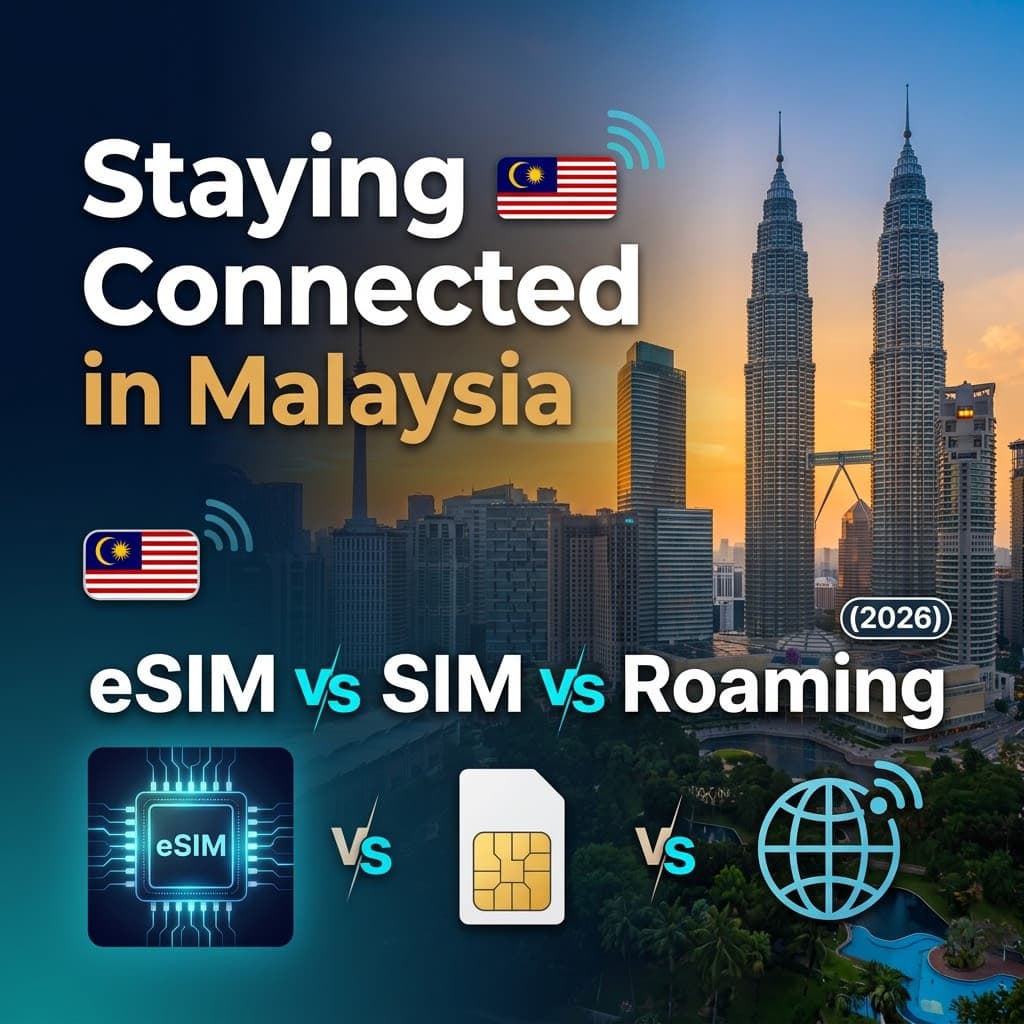
Short answer: for Malaysia in 2026, an eSIM beats both roaming and a local SIM for most travelers — roaming charges far more per GB, and local SIMs now require passport and biometric registration at purchase. An eSIM matches local-network coverage with no shop visit, and you can set it up before you land.
Why you need data the moment you land
Malaysia runs on apps. You'll need data to show your MDAC arrival QR code, book a Grab out of KLIA, navigate with Google Maps, find hawker stalls, and message your hotel. Relying on patchy free Wi-Fi means standing in arrivals trying to load a map. Sorting your connection before you fly removes that stress entirely.
Option 1: International roaming
The simplest option — your home plan just works in Malaysia — but usually the priciest.
- Pros: Zero setup, keep your number, works on arrival.
- Cons: Expensive daily rates and data caps; on a week-plus trip the bill adds up fast.
- Best for: Very short trips where you'll barely use data, or plans that include Malaysia at no extra cost.
Option 2: Local Malaysian SIM card
Buy a prepaid SIM from CelcomDigi, Maxis (Hotlink), or U Mobile after you arrive.
- Pros: Cheap local rates and lots of data; CelcomDigi has the widest coverage.
- Cons: Under 2026 rules, registration now requires your passport, a biometric photo, and a local address — adding 10–20 minutes at the airport. You also swap out your physical SIM (and can lose it) and lose your home number while it's in.
- Best for: Long stays where maximum data for minimum cost matters most.
Option 3: Pocket Wi-Fi
A rentable hotspot device that shares Wi-Fi across several devices.
- Pros: Connects multiple devices; can suit groups or families.
- Cons: Another gadget to carry and recharge, a daily rental cost, and pickup/return logistics. If it runs flat, everyone is offline.
- Best for: Groups who want one shared connection and don't mind managing a device.
Option 4: eSIM (the recommended choice)
A digital SIM you buy online and install by scanning a QR code — no physical card, no kiosk, no registration paperwork.
- Pros: Set up before you fly; activates the moment you land; keep your home number on your normal SIM; fixed price with no bill shock; skips the new SIM-registration process entirely.
- Cons: Your phone needs to support eSIM (most models from 2018 onward do).
- Best for: Almost every traveler — especially first-timers and multi-city Malaysia routes.
Side-by-side: which wins for Malaysia?
- Cheapest for a 1–2 week trip: eSIM (fixed, affordable prepaid pricing).
- Most convenient: eSIM (install at home, online on arrival, no registration queue).
- Best to keep your own number: eSIM (runs alongside your home SIM).
- Best for very long stays / max data: Local SIM (CelcomDigi).
- Best for groups sharing one connection: Pocket Wi-Fi.
- Best for short trips with inclusive roaming: Just use roaming.
For the typical traveler spending a week or two in Malaysia, an eSIM wins on price, convenience, and peace of mind — and it dodges the new airport registration step.
Ready to pick a plan?
Setup takes a couple of minutes and the steps are the same for every provider, so we have not repeated them here. Our best eSIM for Malaysia guide walks through choosing a data size, buying, and installing step by step — and you can browse live Malaysia plans there too.
Quick FAQ
Is roaming or a local SIM better for Malaysia?
Neither wins outright on its own: roaming is the simplest but costs far more per GB, while a local SIM is cheap but now needs in-store registration with your passport and biometrics. An eSIM sidesteps both problems with near-local pricing and zero-shop setup.
Is an eSIM better than a local SIM in Malaysia?
For most travelers, yes — especially now that local SIMs require passport, biometric, and address registration at purchase. An eSIM gives you nearly the same local-network coverage without any of that, and you can set it up before you travel.
Will my phone support an eSIM?
Most phones from iPhone XS, Google Pixel 3, and recent Samsung Galaxy models onward support eSIM. Check your phone's settings or manufacturer to confirm.
Can I keep WhatsApp and my number while using an eSIM?
Yes. The eSIM handles data while your normal SIM keeps your number active, so WhatsApp, calls, and texts all stay on your home number.
How much data do I need for a week in Malaysia?
Around 5–8 GB covers a week of typical tourist use — maps, Grab, social, and photos. Heavy users or those tethering a laptop should size up or choose an unlimited-style plan.
Final word
For a Malaysia trip in 2026, the math is simple: an eSIM is the cheapest, easiest, and most reliable way to stay connected for almost everyone — and the only option that skips the new SIM-registration queue. Set it up before you fly and you'll never think about it again.
Ready to connect? Browse Corelinx eSIM plans and use code COREFREE26 for up to 26% off. New to eSIMs? Start with our best eSIM for Malaysia guide.