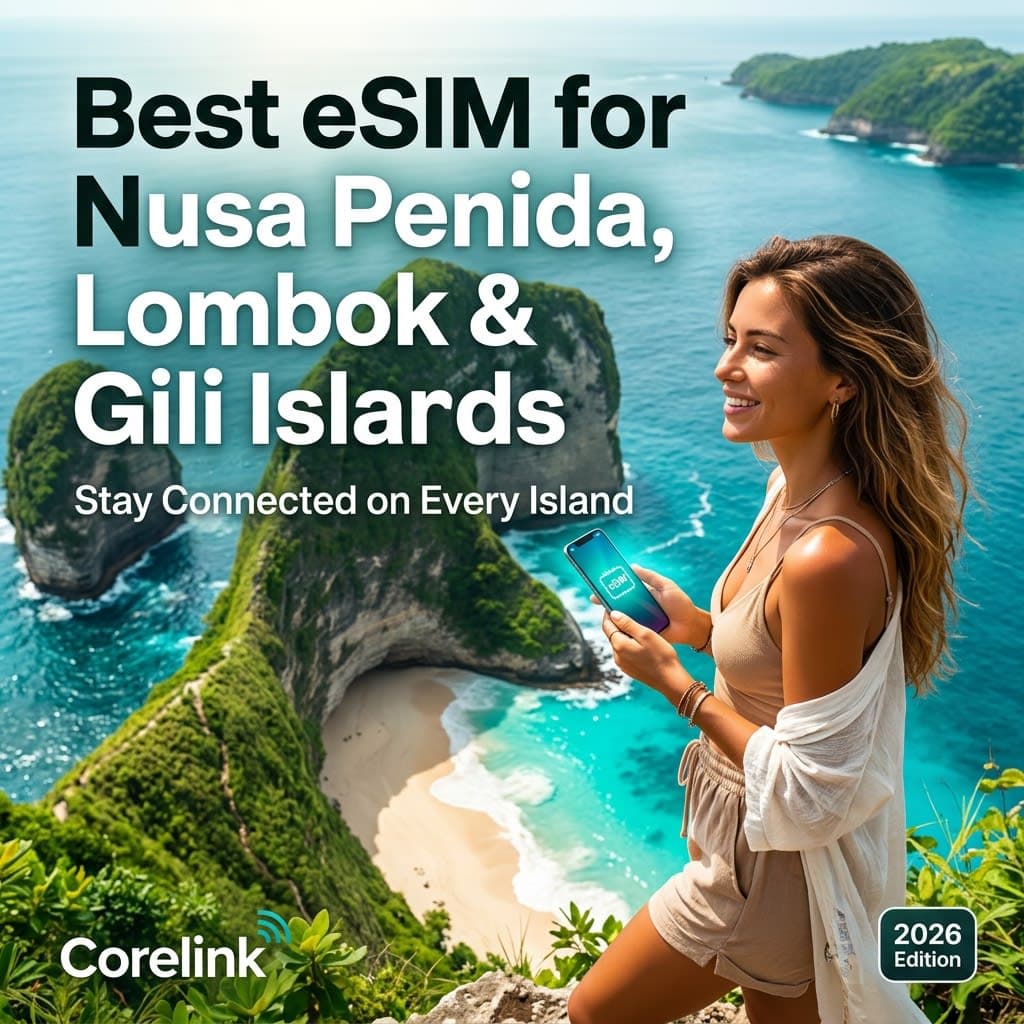
Why staying connected on Nusa Penida, Lombok and the Gili Islands takes a little planning
Mainland Bali is well covered and easy — you can almost feel the signal follow you from Seminyak to Ubud. The islands to the east and southeast are a different story, which is exactly why the best eSIM for Nusa Penida, Lombok and the Gili Islands is worth a few minutes before departure. These are smaller, spread-out places reached by fast boat, and your connection matters most where it is hardest to get: on a rocking boat, at a remote clifftop viewpoint, or on a tiny island with no cars.
Think about how much of a trip now runs through your phone. You will likely use it to:
- Pull up maps to viewpoints like Kelingking, Angel's Billabong or Diamond Beach on Nusa Penida.
- Book or confirm fast-boat tickets between Bali, Lombok and the Gili Islands.
- Message your hotel, dive shop or driver — many coordinate entirely over chat apps.
- Pay with mobile wallets and check the weather before a snorkeling run.
- Share your live location and stay reachable for safety while you are out on the water.
Coverage can genuinely thin out in remote coves and mid-crossing between islands, so the smart move is to arrive already connected and keep offline maps as a backup. An eSIM handles the first half of that beautifully: it gets you online the second your plane or boat lands, instead of leaving you stranded and searching for a signal.
eSIM vs buying a local SIM at the airport or harbor
The traditional approach is to land at Bali's Ngurah Rai airport or Lombok International Airport, find a counter, hand over your passport, and swap in a physical SIM card. It works, but it eats into your first hours: queues after a long flight, a possible language barrier, and the fiddly job of popping out your home SIM. Once that card is out, the calls and one-time passcodes on your regular number can go missing too.
A travel eSIM flips that around. It is a digital SIM you buy and install before you leave home, so there is nothing physical to collect or swap. Here is how the two compare in practice:
- Setup: a local SIM means finding a counter on arrival; an eSIM is bought online in advance and activated in minutes.
- Your home number: most eSIM-capable phones run dual SIM, so your home line stays active for calls and OTP codes while the eSIM carries your data.
- Arrival: with an eSIM you step off the boat already connected instead of looking for a shop.
- Convenience: no tiny plastic card to track, and nothing to hand back at the end of the trip.
For a deeper side-by-side, our comparison of an eSIM vs a SIM card in Bali breaks down the trade-offs, and the same logic carries straight over to Nusa Penida, Lombok and the Gilis. For the wider picture on connectivity across the archipelago, the eSIM Indonesia guide for tourists is a helpful hub.
How to buy and activate your Corelinx eSIM before you fly
Getting set up is refreshingly quick, and doing it at home on your own Wi-Fi means you land ready to go. Here is the simple flow:
- Check your phone supports eSIM. Most recent iPhones and flagship Android models do. If you are unsure, dial *#06# and see whether an EID number appears.
- Pick a plan. Browse the options on the Corelinx packages page and choose one that matches how long you will be island-hopping and how much data you expect to use.
- Check out and receive your eSIM. After purchase you get everything you need to install it, usually as a QR code or a guided in-app setup.
- Install and label it. Add the eSIM in your phone's settings and give it a clear name like "Travel" so you never mix it up with your home line.
- Set your data line and switch on data roaming for that profile. This lets it connect to local partner networks, and it does not trigger charges from your home carrier because the data runs through your eSIM plan.
- Arrive and connect. When you land in Bali or Lombok, your eSIM connects automatically — no counter, no queue.
If you would like the full walkthrough with troubleshooting, the how it works page lays out each step, and the FAQ answers the little questions that come up right before a trip. Since most island trips launch from Bali anyway, the practical tips in our Bali travel guide for first-timers are worth a skim too.
How to choose the right data plan for your island trip
There is no single "best" plan — the right one depends on your route and your habits. Rather than quote numbers that change over time (always check the current options on the packages page), match your trip to one of these common traveler profiles:
- The day-tripper. Popping over to Nusa Penida for a single day of viewpoints? You mostly need maps, ride coordination and a few photo uploads — a shorter, lighter plan usually covers it.
- The snorkeler or diver on the Gili Islands. Days spent in the water mean light phone use: messaging, some maps, and evenings of scrolling. A modest plan tends to be plenty, and you will lean on offline maps while you are at sea.
- The longer Lombok stay. Trekking toward Rinjani, chasing surf in Kuta Lombok, or exploring waterfalls over a week adds up to more navigation and uploads, so a longer-duration plan makes sense.
- The remote worker. Answering emails from a café on Gili Air or taking calls from Lombok? Treat data as a work tool and choose a more generous plan.
- The family or group. Sharing one connection via hotspot? Pick a plan with more room and let one phone tether the others.
Whatever your profile: download offline maps before you leave Wi-Fi, keep a rough estimate of your daily usage so you are not caught short, and remember that video streaming burns through data far faster than maps and messaging. If your plans change, it is easy to top up rather than over-buy. For how the islands fit into a longer itinerary, the complete Bali eSIM guide is the pillar that ties the whole cluster together.
Frequently asked questions
Does my phone support an eSIM for Nusa Penida, Lombok and the Gili Islands?
If your phone is a reasonably recent iPhone or a flagship Android device, it very likely supports eSIM. The quickest check is to look in your phone's mobile or SIM settings for an "Add eSIM" option, or dial *#06# and see whether an EID number appears alongside your IMEI. Older or budget handsets may be physical-SIM only, so it is worth confirming before you buy.
Will an eSIM work on the boats between Bali, Nusa Penida, Lombok and the Gilis?
Signal is generally strongest near towns, harbors and the main tourist areas, and it can drop out mid-crossing on open water — that is true of any SIM, physical or digital. The reliable habit is to download offline maps and screenshot your boat tickets before you set off, so a temporary dead zone never leaves you stuck. Once you reach the next island, your eSIM reconnects automatically.
Can I keep my home number while using a travel eSIM?
Yes, on most eSIM-capable phones. Because the eSIM sits alongside your existing SIM, your home number stays active to receive calls and one-time passcodes while the eSIM handles your data. Just set the eSIM as your data line and, if you want to avoid surprise charges, keep data roaming switched off for your home line.
How much data do I need for an island-hopping trip?
It depends on your habits, so treat any figure as an estimate. Light users who mainly rely on maps and messaging get by on much less than travelers who stream video or work online. A good approach is to estimate your daily use, add a small buffer for boat delays and shared hotspots, and pick a plan on the packages page that matches — you can always top up if you run low.
Ready to island-hop without dropping offline?
Nusa Penida, Lombok and the Gili Islands reward travelers who show up prepared, and staying connected is a big part of that. With a Corelinx travel eSIM you can skip the airport SIM counter, keep your home number for calls and OTP codes, and step off the fast boat already online and ready to navigate. Set it up in a few minutes at home, choose a plan that fits your route, and spend your energy on the views instead of the signal bars.
Browse the Corelinx packages to find the right fit for your trip, and use code COREFREE26 for up to 26% off — see the current deals on the promo page. If you get stuck at any point, our support team is ready to help you get connected before you go.