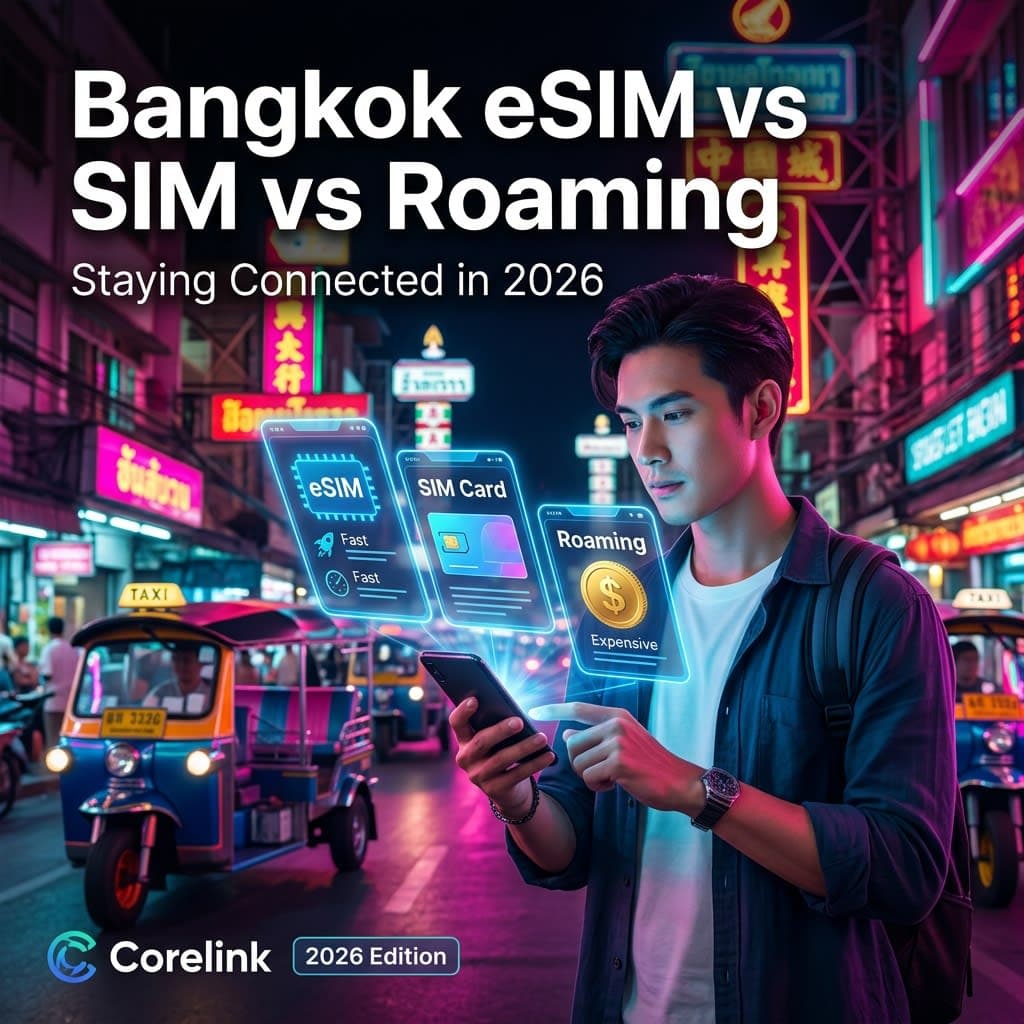
Bangkok is one of the most visited cities in Southeast Asia, and staying connected there is about far more than scrolling social media. You will lean on mobile data for ride-hailing and taxis, temple and mall navigation, translation apps at street-food stalls, and mobile banking to split the bill. The good news: getting online is easier than it has ever been, and you no longer need to gamble on a random airport kiosk. Let us break down your options.
Staying Connected in Bangkok: Your Three Options
Before you pick, it helps to understand what each option actually is and why it matters for a trip to Thailand.
- eSIM (embedded SIM): A digital SIM you install by scanning a QR code — no physical card, no swapping trays. You can buy a Bangkok eSIM online before you fly and have it ready the moment you land.
- Local prepaid SIM: A physical Thai SIM card bought at the airport or a convenience store. It works well, but it means finding a counter, showing your passport for registration, and swapping out your home SIM.
- International roaming: Keeping your home plan active abroad. It is the most familiar option and the least hands-on, but it is also usually the most expensive way to use data in Bangkok.
Why does the choice matter? Because the wrong option can mean arriving with a dead phone, losing access to your home number, or watching a roaming bill balloon after a few days of maps and video calls. Matching the option to how you actually travel saves you money and stress. For a wider view of connectivity across the country, our Thailand eSIM guide covers coverage beyond the capital.
Why an eSIM Wins for Most Bangkok Travelers
Once you compare them side by side, an eSIM tends to combine the best of both worlds: the convenience of roaming with the value of a local SIM. Here is how a Bangkok eSIM stacks up against the older ways of getting online.
eSIM vs a local SIM card
A local SIM can be cheap, but the experience is clunky. You land tired, hunt for an open counter, hand over your passport for mandatory registration, wait while it is set up, and physically remove your home SIM — which you then have to keep safe and remember to reinsert on the way home. With an eSIM, you skip all of that. You install it before departure and simply switch it on when you arrive. Because an eSIM sits alongside your physical SIM, your home number stays reachable for calls and one-time passwords from your bank, while your Bangkok eSIM handles all your data.
eSIM vs international roaming
Roaming is effortless but rarely economical. Traditional roaming charges you home-operator rates to piggyback on a Thai network, and costs can climb quickly once you start using maps and streaming. A travel eSIM instead gives you a dedicated data allowance at traveler-friendly pricing, so you know what you are getting before you go. You still keep your home SIM in the phone for essential calls and texts — you are simply routing data through the more affordable option.
The practical takeaway: for most short-to-medium trips, an eSIM delivers roaming-level convenience at closer-to-local pricing, without the airport queue. If you are weighing this exact trade-off for another destination, our Malaysia eSIM vs SIM vs roaming comparison follows the same framework.
How to Buy and Activate a Bangkok eSIM with Corelinx
Getting set up is genuinely a few-minute job, and you can do it from your sofa days before your trip. Here is the step-by-step.
- Check that your phone supports eSIM. Most recent iPhones and flagship Android models are eSIM-ready. A quick way to check is to dial *#06# and look for an EID number, or open your device settings.
- Choose a Thailand plan. Browse the options on the Corelinx packages page and pick a data allowance and validity that match your trip length.
- Buy online and receive your QR code. Complete checkout and you will get your eSIM details, usually within minutes, ready to install.
- Install the eSIM. Scan the QR code (or use one-tap install) to add the eSIM profile to your phone. You can do this on your home Wi-Fi before you fly.
- Switch it on in Bangkok. When you land, enable the eSIM line and turn on data roaming for that profile — this simply lets it connect to a local partner network — and you are online.
If you would like the process explained in more detail, our how it works page walks through installation on different devices. The whole point of a Bangkok eSIM is that the technical part is done before you travel, so your arrival is smooth.
Which eSIM Plan Fits Your Trip? Pick by Traveler Profile
There is no single "best" plan — the right choice depends on how you travel. Prices and exact data amounts change over time, so treat the guidance below as a general starting point and confirm current options on the packages page (any figures here are estimates only).
- The weekend city-breaker: If you are in Bangkok for a few days of temples, markets and rooftop bars, a lightweight plan focused on maps, messaging and the occasional upload is usually plenty.
- The two-week explorer: Pairing Bangkok with Chiang Mai or the islands? Choose a longer-validity plan with a comfortable data buffer so you are covered across the whole itinerary. Our Chiang Mai first-timer guide and Phuket guide can help you plan the route.
- The remote worker or heavy user: If you will be taking video calls, tethering a laptop, or uploading content, opt for a generous or unlimited-style allowance so your workflow never stalls.
- The family or group traveler: Each phone needs its own eSIM, so budget one plan per device — or consider a single larger plan on one hotspot phone that the others connect to.
New to the city itself? Pair your connectivity plan with our Bangkok travel guide for first-timers to map out neighborhoods, transport and must-sees before you go.
FAQ: eSIM vs SIM vs Roaming in Bangkok
Is an eSIM better than a local SIM card in Bangkok?
For most travelers, yes. A Bangkok eSIM gives you the same local-network access as a Thai SIM without the airport queue, passport registration, or the risk of losing your home SIM. A local SIM can still make sense for very long stays, but for a typical trip the eSIM is faster and more convenient.
Will I keep my home phone number if I use an eSIM?
Yes. An eSIM runs alongside your existing physical SIM, so your home number stays active for calls, texts and banking one-time passwords. You simply set the eSIM as your data line while you are in Thailand.
Do I need to turn on data roaming for my eSIM to work?
Usually yes, and it does not cost extra. Toggling "data roaming" on the eSIM profile lets it connect to a local partner network in Thailand. Because it is a travel data plan, you are not billed home-operator roaming rates — the allowance is already included in what you paid.
When should I install and activate my Bangkok eSIM?
Install it before you fly, while you still have Wi-Fi at home — that is the low-stress way to do it. In most cases you only switch the line on and enable roaming once you land in Bangkok, so your allowance starts when your trip does. Always check the specific plan details on the packages page before you buy.
Get Online the Moment You Land
Staying connected in Bangkok does not have to mean airport queues or roaming-bill anxiety. For the majority of travelers, a Bangkok eSIM is the sweet spot: buy it before you fly, land with data already working, and keep your home number live for anything important. A local SIM suits very long stays, and roaming is fine in a pinch — but the eSIM usually wins on convenience and value together. Ready to sort your connectivity in a couple of minutes? Explore Corelinx Thailand eSIM plans and use code COREFREE26 at checkout for up to 26% off. Want the bigger picture first? Start with our eSIM traveler hub or check current deals on the promo page.